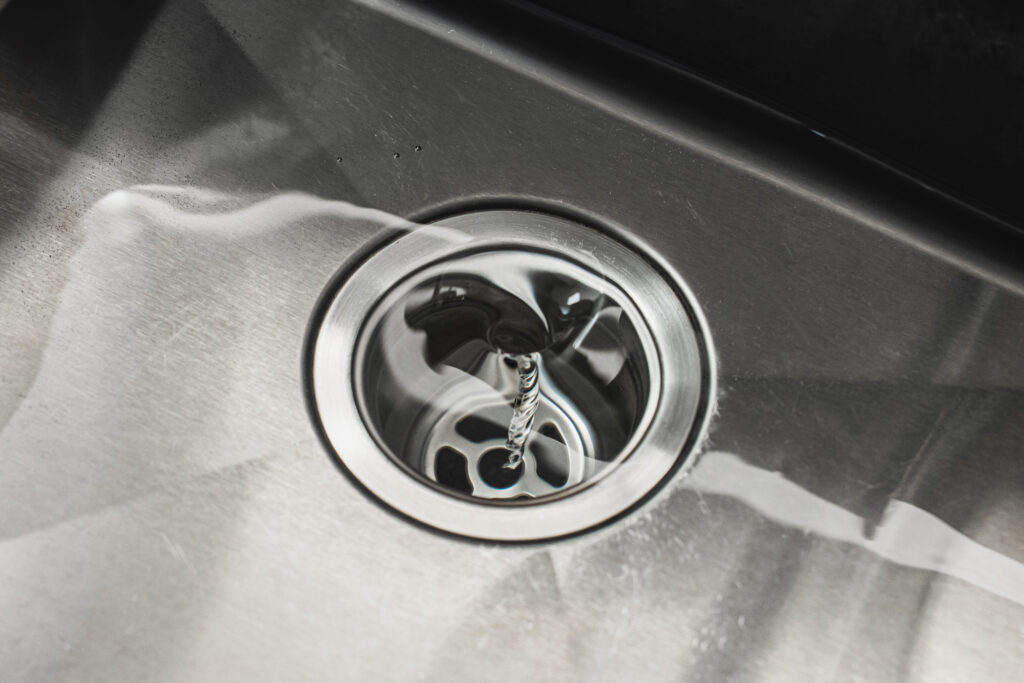
Sinks, baths and showers usually begin draining slowly because material has accumulated inside the waste outlet, trap or pipe. Hair, soap, grease, food residue and limescale can gradually narrow the route through which wastewater must travel.
A single slow outlet may have a straightforward local blockage. When several fixtures are affected, the problem may sit further along a shared waste pipe or drainage connection. Persistent slow drainage can also result from pipework with an insufficient fall, damaged fittings, poor ventilation or ageing above ground drainage.
The cause matters because clearing the nearest visible obstruction will not solve every drainage problem. A sink may appear to improve for a few days before slowing again because the main build-up remains inside the pipe.
Understanding the warning signs helps homeowners decide which simple checks are reasonable and when professional plumbing services are needed.
Why do kitchen sinks drain slowly?
Kitchen sinks regularly receive substances that can settle inside the waste system.
Grease and cooking fat are among the most common causes. They may enter the sink as warm liquids and appear to wash away, but they cool and solidify further along the pipe.
The sticky layer then catches food particles, coffee grounds, flour, detergent residue and other debris. Over time, the opening becomes narrower and water drains more slowly.
Even homes that avoid pouring visible fat down the sink can develop build-up. Small quantities remain on:
- Frying pans and roasting dishes
- Plates and serving utensils
- Food containers
- Baking trays
- Kitchen equipment
- Washing-up water
Dishwashing liquid does not permanently dissolve fat. It may temporarily break it into smaller droplets, but the grease can still collect as it moves through cooler pipework.
Food waste is another major contributor. Rice, pasta, vegetable peelings and coffee grounds can swell, clump or become trapped in the waste fitting.
A kitchen sink waste unit is designed to carry water and small residues, not dispose of every type of food waste. Scraping plates into a food-waste bin before washing can significantly reduce the amount entering the pipe.
Why do bathroom sinks become blocked?
Bathroom basins collect a different mixture of materials.
Soap, toothpaste, shaving foam, cosmetics, hair and skin oils can combine inside the waste fitting. These deposits often gather around the pop-up plug mechanism or immediately below the basin.
Small items can also fall into the outlet, including:
- Jewellery
- Toothpaste caps
- Contact lenses
- Cotton buds
- Dental floss
- Razor guards
- Pieces of soap
Dental floss and hair can wrap around internal fittings, creating a framework that traps further residue.
Some homeowners notice that the basin drains slowly only when the plug is installed. In this case, the plug mechanism may be sitting too low or restricting the outlet.
If removing the plug improves drainage immediately, cleaning or adjusting the mechanism may solve the issue. If the water remains slow, the blockage is likely to be further down.
What causes baths and showers to drain slowly?
Hair is the most common cause of slow drainage in baths and showers.
Loose strands collect around the waste cover, inside the trap and along rough surfaces within the pipe. Soap, shampoo, conditioner and body oils then bind the hair together.
This creates a dense obstruction that water can initially pass around. As more material collects, the water begins to pool around the shower waste or remains in the bath for longer after the plug is released.
Signs of a developing shower blockage include:
- Water gathering around your feet
- The tray taking longer to empty
- Gurgling sounds from the waste
- Unpleasant smells
- Water returning after the shower is switched off
- Debris appearing around the waste cover
A bath may drain reasonably well when partly filled but slow significantly as the water level drops. This can indicate that the pipe is only partially blocked.
Bath and shower wastes are often less accessible than sink traps, particularly where pipework is concealed beneath tiled floors, bath panels or fixed shower trays.
This makes prevention and early action especially valuable.
How does soap contribute to blocked waste pipes?
Soap residue can form a sticky deposit inside waste pipework.
Traditional soap reacts with minerals in hard water to create soap scum. Shampoo, shower gel and other products can also leave residues that cling to hair and grease.
The deposits may build up around:
- Waste covers
- Plug mechanisms
- Trap bends
- Pipe joints
- Sections with weak flow
- Rough or damaged internal surfaces
Soap alone may not completely block a waste pipe, but it helps other material adhere to the pipe wall.
Where water flow is already reduced by hair or grease, soap residue accelerates the process.
Regularly removing visible deposits around bathroom outlets can slow the build-up, although concealed pipework may still need cleaning when drainage repeatedly deteriorates.
Can limescale cause slow drainage?
Limescale can contribute to restricted flow, particularly in hard-water areas.
Minerals carried in the water can settle around metal waste fittings, traps and the inside of pipes. The deposits may narrow the opening or create a rough surface that catches hair and soap.
Limescale is more commonly associated with taps, shower heads and hot-water appliances, but it can also affect drainage components.
A crusty white deposit around a waste fitting may indicate mineral build-up. Cleaning the accessible area can improve flow, provided the product used is suitable for the material.
Do not assume every white deposit is harmless limescale. A small leak may evaporate and leave minerals around a joint, so check whether the fitting is damp or stained beneath the surface.
What is the purpose of the waste trap?
The trap is the curved or shaped section beneath a sink, basin, bath or shower.
It holds a small amount of water, creating a seal that helps prevent smells and gases from the drainage system entering the room.
Because the trap changes the direction of flow, it is also a common place for debris to collect.
Sink and basin traps are often accessible inside a cupboard or beneath the fixture. Bath and shower traps may be hidden below the floor or behind a panel.
A blocked trap can cause:
- Slow drainage
- Gurgling
- Unpleasant smells
- Standing water
- Leaks if joints are disturbed
An accessible plastic trap can sometimes be removed and cleaned by a confident homeowner. A container should be placed beneath it because it will contain water and debris.
Every washer and seal must be refitted in the correct position. Overtightening plastic fittings can damage them, while loose joints may leak.
If the trap is old, corroded, inaccessible or connected to fragile pipework, it is safer to ask a plumber to inspect it.
How can you tell where the blockage is?
The number and location of affected outlets provide useful clues.
Only one fixture is slow
When one sink, basin, bath or shower drains slowly while everything else works normally, the blockage is probably close to that fixture.
It may sit in the plug mechanism, waste fitting, trap or short pipe immediately beyond it.
Several fixtures in one room are slow
If the basin, bath and shower in one bathroom all drain poorly, they may share a restricted branch pipe.
The problem is likely to be further along than the individual traps.
Fixtures in different rooms are affected
When several outlets across the property are slow, the blockage could involve a larger waste or drainage pipe.
This may require professional investigation, particularly if toilets are also affected.
Water appears in another fixture
If emptying the bath causes water to rise in the shower tray, the obstruction is probably beyond the point where their waste pipes connect.
The water cannot move forwards freely, so it follows the easiest alternative route.
The problem changes with weather
Drainage that worsens during heavy rain may involve an external system, surface water problem or shared drainage issue rather than an ordinary local blockage.
These patterns do not provide a complete diagnosis, but they help determine whether simple cleaning is likely to be enough.
Why does the waste pipe gurgle?
Gurgling happens when air is pulled or pushed through water in the waste system.
A partial blockage can restrict both wastewater and air movement. As water passes the obstruction, it creates pressure changes that draw air through the trap.
Gurgling may also result from poor drainage ventilation.
Waste systems need air to allow water to flow smoothly. Without suitable ventilation, draining water can create negative pressure and disturb the water seal in a nearby trap.
Possible causes include:
- A partial blockage
- An incorrectly installed waste pipe
- Poor ventilation
- A blocked vent
- An excessively long unventilated pipe run
- Incorrect pipe sizing
- Several fixtures connected badly
An occasional quiet sound may not indicate a serious fault. Loud, repeated gurgling combined with smells or slow drainage should be investigated.
If a trap loses its water seal, unpleasant drainage odours may enter the room.
Can badly installed pipework cause slow drainage?
Yes. Wastewater usually relies on gravity to move away from sinks, baths and showers.
The pipe must have a suitable fall, meaning it slopes in the correct direction. Too little fall allows water and debris to move slowly. A pipe that falls too steeply can also cause problems if water runs ahead and leaves solids behind.
Poor installation may include:
- Pipes that sag between supports
- Incorrect gradients
- Excessive bends
- Pipes that are too narrow
- Poorly arranged junctions
- Long horizontal runs
- Inadequate ventilation
- Waste connections fitted against the direction of flow
Flexible waste pipes are sometimes used to overcome awkward alignment beneath sinks. Their ridged interiors can catch debris more easily than smooth rigid pipework, especially if they sag.
A waste pipe may work initially and become problematic only after deposits accumulate in a poorly flowing section.
Repeated clearing without correcting the layout will provide only temporary relief.
Can damaged pipes restrict drainage?
Waste pipes can crack, deform, separate or collapse.
Above ground plastic pipework may be damaged by impact, heat, poor support or building movement. Older metal waste pipes can corrode internally and become rough or restricted.
A damaged joint may allow wastewater to leak into a cupboard, floor void or wall while also admitting air into the system.
Signs of damaged pipework can include:
- Persistent smells
- Damp patches
- Staining beneath a bathroom or kitchen
- Repeated blockages in the same place
- Water escaping from joints
- Visible sagging
- Unusual movement when the pipe is touched
- Evidence of corrosion
A blockage may also form around a damaged internal edge where debris repeatedly catches.
Professional plumbing services can help determine whether the problem requires clearance, local repair or replacement of a larger section.
Can the main drain cause a slow sink, bath or shower?
It can, although local waste blockages are more common.
If the main drainage system becomes restricted, wastewater from several fixtures may struggle to leave the property.
Potential warning signs include:
- Multiple slow outlets
- Toilets flushing poorly
- Water rising in a shower or bath
- Gurgling from several fixtures
- External gullies overflowing
- Strong drainage smells
- Wastewater appearing at a low-level outlet
A main-drain blockage can worsen quickly as more water is used.
Homeowners should reduce water use and arrange professional assistance if wastewater is backing up into the property.
The responsible party depends on the location of the blockage. A problem inside the property’s private drainage may be the homeowner’s responsibility, while a blockage in a shared or public sewer may need to be reported to the regional water and sewerage company.
Why does a drain smell even when water still flows?
Unpleasant smells can appear before a pipe becomes completely blocked.
Food, grease, hair and soap trapped in the waste can decompose and produce odours. Bacteria grow within the organic material, especially where warm water and poor flow create favourable conditions.
Other possible causes include:
- A dry trap
- A leaking waste joint
- A damaged pipe
- Poor ventilation
- A loose appliance hose
- An overflowing external gully
- A partial blockage
- A missing or incorrectly fitted seal
A little-used fixture may develop smells because the trap water has evaporated. Running water can restore the seal.
If the smell returns quickly, the trap may be losing water through siphoning, leakage or poor pipework design.
Do not simply cover the smell with disinfectant. The source should be identified, particularly if there are signs of a leak or drainage gases entering the room.
Which DIY methods are reasonable to try?
A homeowner can carry out a few low-risk checks before calling a plumber.
Start by removing visible debris from the waste cover or plug mechanism. Hair can often be lifted from a shower waste without dismantling the pipe.
For a sink or basin, clean the plug and inspect the opening with a torch.
A rubber plunger may help clear a soft local blockage. Seal any overflow opening with a damp cloth so the pressure acts through the waste pipe.
Warm water can help move light grease deposits in kitchen waste pipes, but boiling water should not be poured into materials that may be damaged by high temperatures.
An accessible trap can be removed and cleaned if:
- The water supply is not involved
- The fitting is in good condition
- You understand how the seals are arranged
- A container is placed beneath it
- The pipework is not fragile
- You can check carefully for leaks afterwards
Stop if the fitting will not move easily or if corrosion, cracking or previous sealant repairs are visible.
Should bicarbonate of soda and vinegar be used?
Bicarbonate of soda and vinegar are often recommended for slow drains.
The reaction produces fizzing that can loosen some light residue near the outlet. It is unlikely to remove a dense plug of hair, a solid object or a substantial grease blockage further along the pipe.
These household products may be relatively mild compared with strong commercial chemicals, but they should still not be mixed with drain cleaners or other substances already in the pipe.
The method may be useful as part of routine cleaning, but repeated use without improvement suggests that mechanical clearance or pipework repair is needed.
Are chemical drain cleaners safe?
Chemical drain cleaners should be used with caution.
Strong products may contain caustic or acidic ingredients that can burn skin, damage eyes and create hazardous fumes.
They may also:
- Remain trapped above a solid obstruction
- Damage some seals, fittings or older pipes
- React with another product
- Make dismantling dangerous
- Provide only temporary improvement
- Hide a structural pipework problem
Never mix chemical products. Dangerous gases or violent reactions can result.
Follow the manufacturer’s instructions exactly and keep the product away from children and pets.
Tell the plumber if a chemical has been used before they open the waste system. They need to know that hazardous liquid may still be present.
Professional clearance is usually the safer choice when the blockage is persistent, inaccessible or affecting several fixtures.
Can drain rods be used on sinks and showers?
Traditional drain rods are intended for suitable external drainage pipes, not small internal waste pipes beneath sinks, baths and showers.
Forcing unsuitable rods or tools into internal waste pipework can damage joints, push the obstruction further away or leave part of the tool trapped inside.
Plumbers may use flexible mechanical cleaning equipment designed for smaller pipework. The tool should be selected according to pipe diameter, bends, material and access.
External drain rods must also be used carefully. Turning them in the wrong direction can unscrew sections inside the drain.
When access and pipe layout are uncertain, professional equipment reduces the risk of damage.
Why does the drain improve and then slow again?
Temporary improvement usually means that part of the blockage has moved or a narrow channel has opened through it.
Water may initially pass more quickly, but remaining deposits begin collecting new debris and the restriction returns.
Recurring blockages can result from:
- Grease coating the pipe wall
- Hair remaining beyond the waste fitting
- Damaged or rough pipework
- An unsuitable gradient
- A sagging section
- Incorrect waste connections
- Scale deposits
- A blockage further along the system
Repeatedly plunging the outlet may manage the symptom without removing the main obstruction.
Where the same fixture blocks every few weeks or months, the pipe should be investigated rather than treated as a series of unrelated incidents.
How does a plumber clear a slow waste pipe?
The method depends on the location and cause of the restriction.
A plumber may begin by inspecting and cleaning the waste fitting and trap. If the blockage is beyond the trap, they may use suitable flexible clearing tools or access the pipe from another point.
The work may involve:
- Removing and cleaning the trap
- Dismantling an accessible waste section
- Using a hand-operated cleaning cable
- Using powered mechanical equipment
- Flushing loosened debris
- Repairing leaking joints
- Replacing damaged pipework
- Correcting the pipe gradient
- Improving support
- Investigating connected outlets
The plumber should also test the drainage after clearance.
Running a small amount of water is not always enough. The system may need to be tested under a realistic flow to confirm that the water clears without backing up or leaking.
When is a camera inspection needed?
Camera inspections are more commonly associated with larger drainage pipes, but small inspection equipment may be used where access and pipe size allow.
A camera can help identify:
- Persistent deposits
- Internal pipe damage
- Poor junctions
- Intruding objects
- Separated fittings
- Deformation
- Repeated obstruction points
It is not required for every slow sink or shower. Many local blockages can be diagnosed through accessible fittings and flow tests.
A camera becomes more useful when the problem keeps returning, several outlets are affected or replacing concealed pipework would otherwise involve guesswork.
When should waste pipework be replaced?
Replacement may be necessary where the pipe itself is causing the problem.
This can include pipework that is:
- Corroded
- Cracked
- Deformed
- Badly sagging
- Incorrectly sized
- Poorly routed
- Repeatedly leaking
- Internally restricted
- Made from deteriorated material
- Inaccessible for proper cleaning
A short damaged section may be replaced locally. More extensive problems may require a revised waste route.
During a bathroom installation or kitchen installation, it is sensible to inspect older waste pipes before they are concealed behind new units, floors or finishes.
Reusing pipework that already drains poorly can undermine an otherwise high-quality renovation.
How can homeowners prevent slow drainage?
Prevention focuses on reducing the amount of solid and sticky material entering the waste system.
In the kitchen:
- Scrape food into the bin before washing
- Wipe grease from pans with kitchen paper
- Do not pour cooking oil down the sink
- Use a sink strainer
- Empty coffee grounds into food waste
- Clean the trap when early slowing appears
In the bathroom:
- Use a removable hair catcher
- Clear the shower waste regularly
- Avoid flushing wipes or cotton products
- Clean soap residue from plug mechanisms
- Do not allow dental floss to enter the basin
- Respond to recurring gurgling or smells
Periodic hot-water flushing may help reduce light soap and grease residue, provided the temperature is safe for the pipe material.
Prevention will not correct damaged or badly installed pipework, but it can greatly reduce ordinary household build-up.
What should landlords do about slow drains?
Landlords should encourage tenants to report slow drainage before a complete blockage or overflow occurs.
An early report may allow a straightforward trap clean or local repair. Delayed action can lead to wastewater damage, unpleasant smells and disruption to several occupants.
The cause should be established before deciding who is responsible for the cost.
A blockage caused by ordinary deterioration, defective pipework or poor installation may fall within the landlord’s maintenance responsibilities. A blockage caused by inappropriate items being placed into the system may be treated differently, depending on the evidence and tenancy agreement.
Landlords should keep records of:
- The tenant’s report
- Inspection findings
- Photographs
- The location of the blockage
- The cause identified
- Work completed
- Advice given
Repeated problems in the same location may indicate that the pipework requires repair rather than another basic clearance.
When does slow drainage become urgent?
Slow drainage becomes urgent when there is a risk of wastewater entering the home or causing damage.
Arrange prompt professional help if:
- Water is backing up into another fixture
- Several outlets are affected
- A toilet is also draining poorly
- Wastewater is overflowing
- There is a strong sewage smell
- Water is leaking beneath floors or cupboards
- The blockage returns immediately after clearing
- A vulnerable occupant has lost access to essential washing facilities
- A chemical cleaner is trapped in the pipe
Stop using affected fixtures if continued use causes water to rise elsewhere.
Where wastewater is near electrical equipment, avoid contact and arrange appropriate assistance.
A single basin that drains slightly slowly may not require an emergency visit, but delaying a worsening blockage can turn it into one.
Frequently Asked Questions
Why does my sink drain slowly even though the trap is clear?
The blockage may be in the pipe beyond the trap. Other possibilities include poor pipe gradient, a partially blocked branch connection or inadequate ventilation. A plumber can test the flow and inspect the wider waste route.
Why does water rise in the shower when the bath empties?
The bath and shower probably connect to the same waste pipe, with a blockage located beyond their junction. Water leaving the bath cannot pass freely and backs up through the lower shower outlet.
Can hair block a bath as well as a shower?
Yes. Hair can collect around the bath waste and overflow connections, particularly where the bath is used with an overhead shower. Soap and conditioner help bind the strands into a dense obstruction.
How often should sink and shower wastes be cleaned?
Visible waste covers and hair catchers should be cleaned whenever debris accumulates. The necessary frequency depends on household use. Internal traps do not need routine dismantling when they are draining properly and leak-free.
Can slow drainage be a sign of a collapsed drain?
It can be, especially when several fixtures are affected and the problem repeatedly returns. However, local blockages and poorly arranged waste pipes are more common. Professional investigation is needed to confirm structural drainage damage.
Sinks, baths and showers normally drain slowly because hair, soap, grease, food or limescale has restricted the waste outlet, trap or pipe. A local blockage may be relatively simple to clear, while several affected fixtures can indicate a problem further along the system.
Recurring slow drainage should not be accepted as normal. Poor gradients, sagging pipes, damaged fittings and ageing above ground drainage can cause the same symptoms to return even after basic cleaning.
For help diagnosing and repairing slow or blocked household waste pipes across Devon, contact Toms & Co Plumbing and Heating on 01752 427417 or email James_toms123@icloud.com.
Find out more: Toms & Co Plumbing and Heating